Every summer since I was born, I have traveled to Bulgaria. As soon as school ended, my sister and I would excitedly pack our suitcases, ready to board flights from New York to Germany and then from Germany to Bulgaria. We anticipated traveling around the country and exploring my mother’s hometown, Kyustendil. But most of all, we eagerly waited to be with our grandparents and enjoy the tranquility of their home. Bulgaria feels different; its rhythm, history, and way of life stand in stark contrast to New York.
Although the term Balkan has a Turkish origin and means mountain, the Balkans’ rich history started in the Neolithic era, and some suggest even earlier. Located between Central Europe and Asia, and because of its proximity to the Bosporus Strait, Bulgaria’s territory has been colonized by several different groups: the Persians, Byzantines, and the Ottomans. Known for their poetry, music, and craftsmanship, the Thracians and their Odrysian Kingdom left a deep mark on the region as well. During the 19th century, Bulgaria went through liberation from Ottoman rule, division by the European powers, followed by Communism and sinking behind the Iron Curtain in the 20th century until the fall of Communism in 1989.
Kyustendil, a regional capital, is a small city about 80 miles southwest of Sofia, close to the border of North Macedonia and Serbia. With its history spanning almost 8,000 years, the city is an excellent example of how much lies underneath a contemporary facade. The names of places trace back to the languages and cultures that once passed through the region and left their mark. The sense of time and history can feel overwhelming. Everywhere you look, there are ancient ruins, Thracian sculptures, Roman walls and mineral baths, remains of an Ottoman mosque, and Communist-era relics. In the middle of the city stand the remains of a Thracian healing center with mineral water pools called the Asklepion, built in the 5th century BCE. There is also an ancient Roman fortress overlooking the city that I have hiked too many times with my family. And yet, it is a relatively poor city that generally goes undetected; many of its historical monuments have no plaques, signs, or explanations. I always wondered how people living in Kyustendil simply accept its fascinating history with a sense of indifference without understanding its actual value.
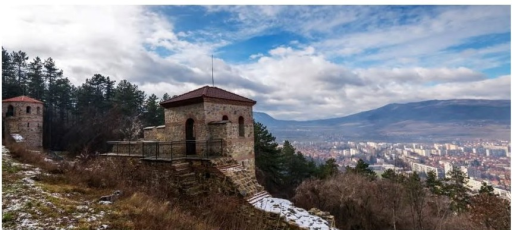
Growing up and spending summers there sparked my curiosity about history and different cultures. My grandfather and I often went on walks through town to run his errands. Exploring the city, I never knew what I might encounter, and I always felt that I would uncover some relic or stumble upon some unexpected story to learn.
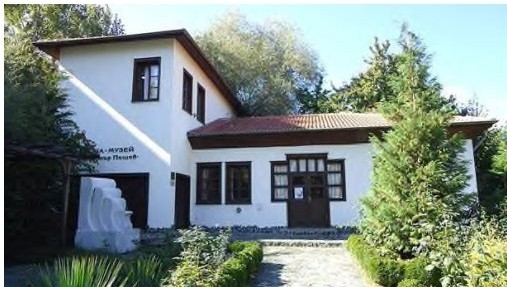
One hot summer day while walking with my grandfather, I saw an interesting house. It had a beautiful yard with flowering bushes and a sign above the door that read, “House- Museum Dimitar Peshev.” Amidst the town’s rich ancient history, it was easy to overlook the historical events that had transpired here during the 19th and 20th centuries. I asked my grandfather about the house, curious about its origin. He explained that it was a replica of the home of Dimitar Peshev, a deputy speaker in the Bulgarian government just before and during the Second World War. More importantly, I learned that Peshev, alongside others, prevented the deportation of Bulgarian Jews to Nazi concentration camps. This discovery struck me. I am deeply connected to both my Bulgarian and Jewish heritage and learning that a Bulgarian figure played a role in saving thousands of Jewish lives felt personal and powerful.
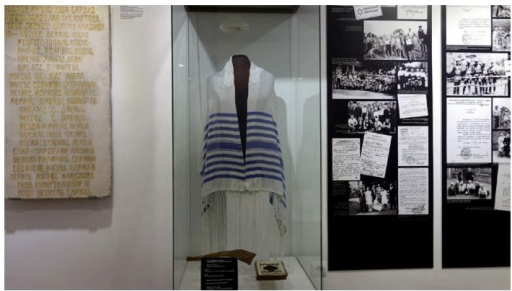
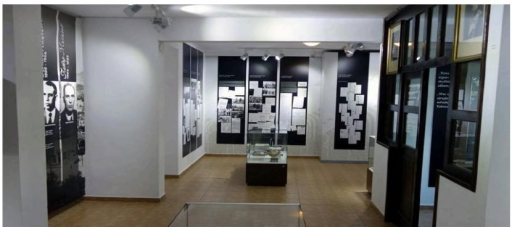
The day we visited the museum, I arrived with my grandfather, eager to learn more about Peshev. The replica of his house was beautiful, built in the traditional Bulgarian style with dark wood, white plaster walls, and a stone foundation. The building was quiet. I paid the admission fee, walked in, maintained its quietness, and began to explore the small museum.
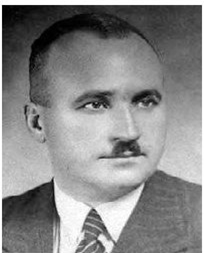
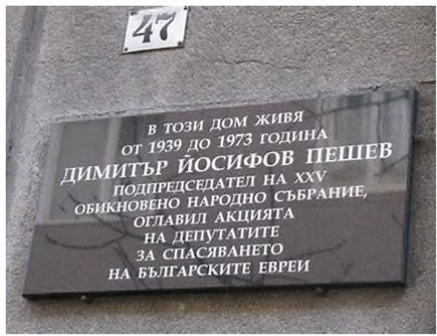
Dimitar Peshev was born in 1894 in Kyustendil to a big family. He enjoyed studying languages and law, eventually becoming an attorney. He entered politics in 1935, becoming the Justice Minister in Georgi Kiosseivanov’s cabinet. He was known as an honest and honorable man by other members of parliament, which helped him win his position as deputy speaker in 1938. His main viewpoints and interests were in upholding the Constitution and protecting human rights. During his time in parliament, he was strongly disliked by the Prime Minister, Bogdan Filov, as Filov prioritized territorial expansion and saw it as more of a priority than Peshev did.
In 1941, Bulgaria joined the Axis for two main reasons. The Bulgarian government hoped to regain territories lost in the Second Balkan War, it feared suffering the same fate as Yugoslavia when its government refused to join the Axis, leading to the invasion and devastation of the country. Shortly after Bulgaria joined the Axis, the Bulgarian parliament was forced to adopt the ironically named “Law on Protection of the Nation,” despite opposition from some members of parliament and other lawmakers. The law severely restricted the rights of Bulgarian Jews. At first, Peshev did not openly oppose the Law on Protection of the Nation.
In 1943, Theodor Dannecker, the Nazi SS captain in charge of Nazi-Jewish affairs, arrived in Sofia to arrange the deportation of Jews from the newly annexed territories of Macedonia, Thrace, and other western territories, which were returned to Bulgaria. The territories were ceded to Bulgaria after the invasions of Greece and Yugoslavia as they were seen as rightful Bulgarian lands. Although Bulgaria technically controlled these lands, the Bulgarian government had no actual jurisdiction over them, as in reality, they were governed by the Nazis. A month later, Dannecker signed an agreement with Alexander Belev for the expulsion of 20,000 Jews from the newly annexed Bulgarian territories. Alexander Belev was appointed as head of the Bulgarian Commissariat for Jewish Affairs since he was an extremely antisemitic and nationalistic member of the Bulgarian government. The number of Jews living in these newly annexed territories was about 13,500, so Belev decided to deport 6,500 Bulgarian Jews as the first step. Parliament voted to approve these decrees so that they were legally justified. Stations were set up for transporting Bulgarian Jews on the Bulgarian national railways as well as with ships along the Danube River. Although this was being done in secret, Jews and non-Jews began to realize what was happening as the word spread. It became apparent that measures against Jews were being taken to deport them from the country. The word eventually got to Dimitar Peshev.
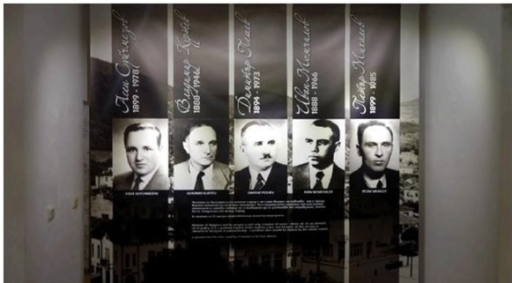
A delegation of forty Jewish and non-Jewish Bulgarians from Kyustendil decided to talk to Peshev in Sofia. Unfortunately, the delegation could not reach Sofia due to a lack of organized transportation. Thankfully, however, four men – Asen Suychmezov, Vladimir Kurtev, Ivan Momchilov, and a Member of the Bulgarian Parliament, Petar Mihalev, met at the railroad station in Kyustendil on the 8th of March in 1943. These are the men who made up the remainder of the delegation, none of whom were Jewish. On March 9th, the delegation arrived in Sofia and informed Dimitar Peshev about the horrors that were to occur. After the war, Peshev wrote, “I had no doubt about what was going to happen, and my conscience and understanding of the real meaning of the plans no longer allowed me to remain a bystander. I decided to do whatever I could to prevent the plans from being implemented.”
Using his authority as the vice president of parliament, Peshev met with the Minister of the Interior, Petar Gabrovski, to address the issue. He was later joined by his supportive colleagues, who helped his efforts. During these meetings, the three presured Gabrovski to stop the deportations of Bulgarian Jews immediately, and soon, the order promptly became public.
During this time, the three other members of the delegation made further efforts to support the cause. They met with Jews from Sofia to inform them of the deportation plan; met with Professor Alexander Stanishev, who advocated for the Bulgarian Jews living in the newly annexed territories, specifically Macedonia; and visited the high-ranking General Nikola Zhekov to ask him to utilize his influence with Nazi officials in Bulgaria. Amidst all of these positive efforts, however, the houses in Kyustendil of the four members of the delegation, plus Peshev’s, became targets of vandalism, violence, and hate crimes. The windows were destroyed, and antisemitic messages were written all over. This, however, did not dissuade these brave men from acting to save the lives of tens of thousands of Bulgarian Jews that were moments away from being sent to Nazi death camps in occupied Poland.
Unfortunately, 11,343 Jews from the new territories were gradually deported as the initial agreement did not cover the new territories. To prevent more Jews from being deported, Peshev wrote a letter to the government to stop all deportations, including from the newly annexed territories. Forty-three members of parliament and the delegates from Kyustendil signed this letter alongside Peshev. The letter was then sent to Prime Minister Filov. However, Filov saw this as an internal rebellion and was infuriated. He then proposed the removal of Dimitar Peshev from his role as vice president of parliament. Even though Filov demanded that the deputies who signed the letter to nullify their signatures, thirty members refused. On March 16th, 1943, Dimitar Peshev received a vote of censure and, on the 24th, was removed from his position in parliament. Although Peshev was removed, the deportations were stopped.
This lasted only a short while, however. Commissariat Belev was planning to restart the deportations by going through the Danube. However, as parliament tried to figure out what to do, the Bulgarian Orthodox Church stepped in to uphold the country’s Christian values. The Holy Synod of the Bulgarian Orthodox Church sent letters to Prime Minister Filov and Tsar Boris III condemning the new attempts at deportation. Bishops Stefan Sofiyski and Kiril Plovdivski became leaders of Bulgarian protests nationwide. These protests, along with further diplomatic action from the two bishops, ended the attempts of further deportation.
In 1944, Bulgaria was liberated from Nazi occupation by the Soviet Union. Directly after, a coup d’etat took the country by storm as a communist government was put into place. After the war, Peshev was arrested and accused of being anti-communist and was wrongly accused of being a Nazi collaborator. He was tried by the Bulgarian People’s Court and was sentenced to fifteen years of prison service but only served one year because of his actions in saving Bulgarian Jews. Peshev’s actions went unrecognized for many years due to the political state of Bulgaria during the Communist regime. Thankfully, in January 1973, Yad Vashem awarded him the title of “Righteous Among the Nations,” one of the most important awards from the State of Israel, alongside Asen Suychmezov, Vladimir Kurtev, Ivan Momchilov, Petar Mihalev, and several other Bulgarians. Sadly, Peshev died that same year on February 20th, 1973.
Because of Dimitar Peshev and his allies’ courage and determination, tens of thousands of Jews were saved from the horrors of the Holocaust. Peshev and his allies risked everything to do what was right, even when silence or complacency would have been easier. This story resonates in today’s world as much as it did eighty years ago. I am very proud that the brave men in my mother’s homeland saved the people of my father’s heritage. It is critically important that good people speak up during times of trouble and to not stay silent, or else the forces of evil will win. This is a lesson that we cannot forget history and a lesson for people today to stand up for what is right and not back down in the face of injustice and evil.
Editor’s Note: All images are originally taken by Tahl Ziegler.