A young, wide-eyed girl pushes open the wooden door—her first glimpse at a dance studio. She’s impressionable. Six years old. Her bare feet step onto the cold, black rubber floor. A nice lady walks up to her, holds her hand, and reiterates a script that needs to be told to every new student. Yet, the girl is enthralled. She giggles as she sits cross-legged on the ground, her shiny black hair in a pink headband bouncing with innocence.
The class begins.
Deafening stamps of their feet jolt her into focus, and she analyzes the movement weaving through the music. Little did she know those tender feet of hers would later become bruised and blistered with an undying fire for perfection, a hunger for achievement, and a love that would grow to be integral to who she was.
This girl had decided she would become a Bharatanatyam dancer.
“What kind of dance do you do?” they ask, leaning in from their seats, intrigued. It’s third grade, and she has a talent show that her mother had signed her up for.
Her mother says she should embrace Bharatanatyam, and that everyone would think it’s cool. She wonders then, why she hesitates when they ask this question, as she looks up and says, “Oh! It’s a classical dance form”
“Oh! Like ballet?” they reply.
“No,” she says, “Not ballet.” though she so desperately wished it were.
“Then what?”
“It’s Indian”
“Bollywood?”
“No, not Bollywood.”
Before she opens her mouth, their cheeks have started pulling into jeering smiles, sharing uncomfortable glances shifting between each other. Her stomach sinks.
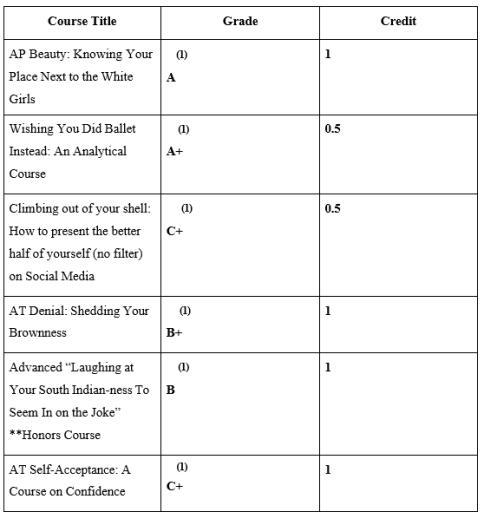
Wishing You Did Ballet Instead: An Analytical Course (A+)
Teacher Comment 1:
Anjali was a delight to have in class, as she was able to appreciate and observe the positive feedback that Western forms of dance receive. She wished she could flaunt soft pink tutus, satin shoes, with orchestra symphonies guiding her body.
Unfortunately, she has been slightly distracted in class, seeming to build a connection with Bharatanatyam, a South Indian dance form. While we have no objections to expressions of other art forms, it is painfully obvious that it is too different, heavy, and lacks the visual ease that comes with, well, anything conventional.
She will be met with forced smiles, and empty gestures of appreciation. We hope to save her from this heartache, and to steer her in the direction of Western influences. She won’t be confronted with uneasiness. I am sure Anjali will understand that the syllabus of this course does not change.
It’s 4th grade Culture Day. She’s only nine-years-old. She comes to school wearing an orange lehenga—a long, flowing skirt with a matching blouse. At nine-years-old, children are still navigating who they are. Still attributing traits and cultures to their sense of self. The teacher stands up and asks the children sitting on the rainbow mat to pick a piece of colored paper, to write down a quality they have that they are proud of.
She picks up a dark shade of purple and writes “fair.”
She is proud of that trait of hers.
Amidst the laughing cheeks, the multi-colored light up sneakers, and the array of headbands and clips on young hair, she too, is colored with content.
Her friend sees the paper.
“You are fair! You always make sure everyone has a fair chance when we play tag.”
Her smile faltered. She had so foolishly forgotten that fair, had also meant equitable. Lowering her eyes to her caramel skin, her face flushed with embarrassment—she had referred to something else.
At lunch, a discussion of hometowns arises. She leaps at the opportunity: “I’m American!” she says with defiance. A defiance for approval, for acceptance, for being considered anything other than “other.” They look at her slightly confused, observing her dark eyes, thick black hair, and chocolate skin.
“But Americans are blonde with blue eyes.”
She fights back. “No, they aren’t! Look at me.”
A strawberry blonde boy retaliates. “You don’t count.”
She didn’t count.
He got to be a “real” American in this lifetime. Lucky him.
AT Denial: Shedding Your Brownness (B+)
Teacher Comment 1: Anjali has done well this semester, and I have greatly enjoyed observing her growth over the past few months. She applies concepts learned in class, which she is able to display by highlighting her American-ness, with the flawless ability of citing family members and her accent as evidence to distance from her Indian-ness. She is able to act confused when somebody asks her a question related to Hinduism, citing that her family is simply not religious. These facts are great examples that she has been able to use as an excuse to dissociate from her South Asian ethnicity. However, her dedication to Bharatanatyam could become a caveat in the future in terms of shedding her brownness. Her next step could be finding a way to hide her passion for the dance. This way, her Indian-ness is only attributed to her— unfortunately inevitable—skin color. We have respect for racial diversity, we simply hope to prepare her for the world she is about to enter, as the social syllabi does not change. It has been silently written behind closed doors. The pen has never been passed on to those who have been stained by its ink
She had better get used to remaining stained. Perhaps, this will save her some heartache.
She is now in high school, has hit puberty, and is looking at boys with something other than irritation.
In her sophomore year, the butterflies in her stomach awoke when she looked at a boy. She dreamt of his tan glow, brunette waves, and light hazel eyes. How naïve she was to think he would see past her skin, as she saw past his. Her heart tugged at the thought of him, blush bloomed into burgundy roses on her cheeks, and shiny lip gloss remained religiously swiped on her lips in the case that he glanced at her in English class, for an entire year.
Soon after, her friend told her she overheard him talking about her. “She’s pretty for an Indian, but I don’t do things with Indians like that,” he had said with a shrug, as he dismissed her worth with a swift movement.
This was expected.
“Compared to the others though, she’s just decent.” By the ‘others’ he had meant the whiter girls.
This was a slap.
Her face lit fiery red, but this time not out of oblivious, youthful yearning, but rather, out of embarrassment. Even if he thought her hair curled in the right way, her nose was sharp enough, her eyes big enough, her lips glossed enough, it would never be enough to beat the other, whiter, girls.
The girls that were soccer players, and ballet dancers.
The girls that were pale with exotic eye colors.
The girls who didn’t even have to think twice if their character, passions, and lifestyles depended on a shade of color.
AP Beauty: Knowing Your Place Next to the White Girls (A):
Teacher Comment 1: Anjali understands that no matter how much she might like a boy, if he isn’t into “brown girls,” she stands no chance. She is a natural at calculating meaning from tone, social contexts, and the impossible possibility of someone who says that “she is pretty for an Indian” to truly see past her caramel complexion. She often wishes that she looked like her whiter friends, perhaps even her East Asian friends. Pale skin against dark hair, delicate freckles against tan skin. Things she would never have. One thing she could work on for the upcoming semester is to be more careful about who she chooses to find romantic interest in. Perhaps this will save her unnecessary heartbreak. Lastly, she could work on an understanding that being pretty for an Indian girl, still means the white girls win. I am looking forward to seeing her eventual adherence to the course syllabus, and the aligning of her interests to more racially homogenous partners/persons of interest.
She is now in her junior year of high school and is watering the roots of her culture. She is not ashamed. They grow deep in her now, wrapping tightly around her soul.
A loud-mouthed boy walks up to her. Indian. She sees herself in him. “What kind of a last name is that?” He laughs at her ten lettered, tongue-twister of a name. “Only South Indians have insane names like that.” She was not surprised by this, nor was it a dent in her honor—she had been jeered for her name by people of all kinds.
He wasn’t finished.
“Yeah, but you can’t tell she’s South Indian…look at her. She isn’t dark, she’s pretty decent.”
She felt her stomach churn. Ingredients of acidic confusion, disgust, and embarrassment, mixed together into a substance of shame.
He still wasn’t done.
“I don’t like Bharatanatyam either.” Though she had begun to feel miniscule, she had also had enough.
“Why?”
“I don’t know, I just hate it.”
Her heart was the last ingredient that sunk into the mixture of nausea in her stomach. She was already bruised internally, numb from the painkiller of the constant “positive self-talk”. That the others were simply ignorant. They did not want to understand her. She did not, however, anticipate being the most hurt by her own kind.
As she was conditioned to find solace in those like her, she had been thrown into the deep end.
Now, who was left?
Advanced “Laughing at Your South Indian-ness To Seem In on the Joke” **Honors Course (B)
Teacher Comment 1: Anjali seems to struggle a bit in this course, though it is commendable she has taken up an honors course without a GPA boost. She seemed to have a hard time accepting the stress of realizing that some North Indians do indeed look down upon South Indians. That there is a line that she can never cross, can never climb over toward the top where they sat. She’d stay under them, not just on the map, but in their minds. Too conservative, too traditional, too dark, too ugly—weeds sprouting from slums. She was slightly confused how one can look down upon another in the same country. She often stood up for herself against those who mocked Bharatanatyam, South Indian food, and her last name. Yet, she found herself to be the only one fighting in her circle of friends. To protect her well-being, it is vital that she develops thicker skin and takes it as a joke. After all, that’s all it is. Unfortunately, society is not for the weak. I hope to see her loosen up a little next semester.
When people say, “How are the slums down there?” It’s never serious. Move on.
She’s finishing her first semester of senior year. The tail end of a marathon, of an existence in a society whose rules she has had to adhere to throughout her adolescent years.
She is now a professional dancer, never having let go of her love for dance which was ignited on that first day at six-years-old.
Through her blistered feet, sore knees, collapsed lungs, and drenched sweat, she found a home. Passion. A community. She opened a social media account the summer before her senior year, excited nerves buzzing through her. She finally decided to climb out of her cocoon, feeling complete with her metamorphosis of confidence.
However, as she slowly neared the first few weeks of senior year, she slowly stopped decorating the account. Funnily enough, no one had said anything this time. They had, however, created a product of their conditioning: her. She became quite natural at hiding herself.
Her recipe of shame crept back, brewing in the back of her mind. Her pride, that she so desperately clawed her fingernails into, slipped away. Perhaps it was better enjoyed for herself.
But now, was she the problem?
Climbing out of your shell: How to present yourself on Social Media (B+)
Teacher Comment 1: Anjali has been doing well in this course, especially in the latter half of the semester. Initially, she was expressing Bharatanatyam on social media. This took levels of anxiety that we saw was detrimental to her well-being. Hence, her later behavior of refraining from posting on a dance account may have been a good choice. She gained followers and momentary pride, however posting Indian clothes as well an Indian dance form became a challenge. The gold jewelry adoring her head seemed garish, the vivid colors wrapping her body were alien, and her makeup was too much. She couldn’t be proud of it.
Unfortunately, we, as a society, cannot change our handbook at the moment, and thus it is easier for Anjali to protect her mental well-being, rather than endure avoidable anxiety. There is less harm in following social norms. I hope you understand.
The ink of our social syllabi still remains, and she still does not have the pen.
She split her life in two. One for the version of herself here, and the other for the version of herself in the future. Amongst the blanket of diversity that expertly tucks the unchanging social syllabi into bed every night, comfortable and ready to seep into the minds of those with a similar shade of caramel, she saw through it, as if it were transparent.
She plans a life in which she could change the recipe of her shame, and instead mends it to foster confidence, and undying pride.
AT Self-Acceptance: A Course on Confidence (C+)
Teacher Comment 1: In this course, students are expected to grow confidence in their identity as according to the societal syllabi. Many students are weak in this subject, so Anjali is not an outlier, and her progress is not something I am worried about. I hope that she is proud of her identity, especially being South Indian, born in the United States, and growing up in Singapore. Our community greatly endorses diversity, though students still struggle with this skill. We, as a societal department, are still evolving this course to target the specific reason why students only seem to meet expectations and are unable to develop holistic confidence in themselves. As of right now, we don’t seem to observe a systemic issue. I hope to see Anjali excel in these areas in the near future. After all, we are such a forward-thinking society these days!
School’s Official Signature: _______________
Date: December 11, 2024
Confidential, Issued to Student.